
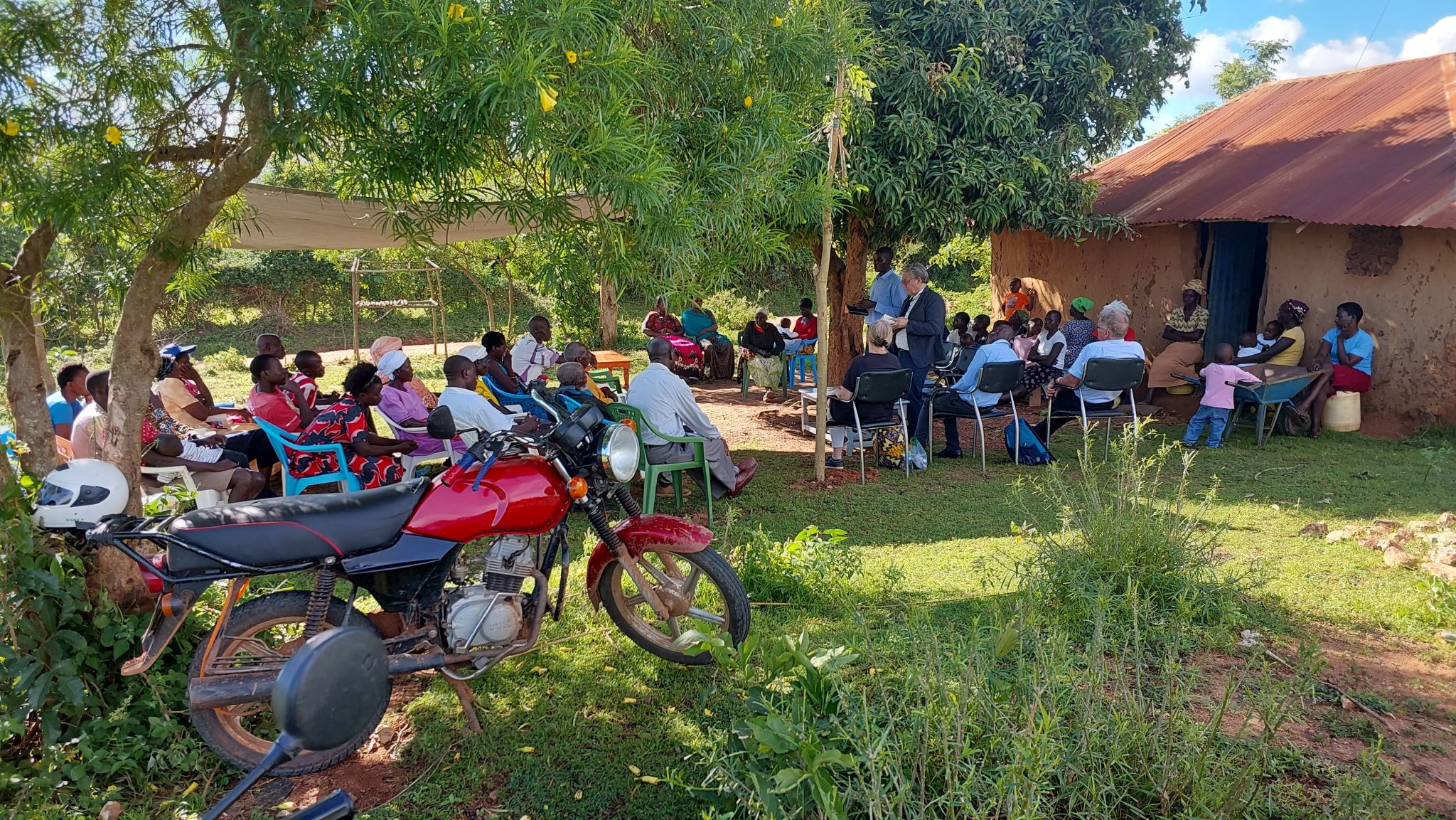
In many languages, a congregation’s preacher or priest is referred to as a “minister.” Strictly speaking, the word means servant and is related to the Latin word “minus,” which means “less” or “inferior.” A minister is thus a servant, who must be “least” among those he serves. But who, according to the Bible, is qualified to serve as a “minister” and proclaim the Word of God?
Priests and laymen as preachers
In Christian churches, the Word of God is often read and explained by ordained priests, who may hold a degree in theology. However, the Christian priesthood is not the same as it was in Israel during biblical times. In Judaism during Jesus’ time, the priests’ main role was to oversee the sacrifices performed in the temple, while the Word of God was usually explained by scribes—that is, men who had studied the sacred scriptures. The ministry of the present-day preacher is thus closer to that of the teacher of the law described in the Bible than to that of the temple priest.
In addition to ordained priests, many Christian communities have lay preachers who have no theological training or office of ministry. In the early days of Christianity, all preachers were laymen. In the Bible, they are compared to shepherds who care for their flocks. The evangelist John describes how Jesus calls Peter to the role of shepherd and gives him three commands: “Feed my lambs,” “Take care of my sheep,” and “Feed my sheep.” (John 21:15–18)
In the Great Commission, Jesus commissioned his apostles to make disciples of people of all nations. The mission comprised two main parts: to baptize them in the name of the Father, the Son, and the Holy Spirit, and to teach them to obey everything Jesus had commanded them to do (Matt. 28:19–20). Feeding and caring, then, involve public reading and explanation of God’s Word, as well as communication of God’s will. The shepherd encourages his flock to believe, advises them to act in accordance with God’s Word, teaches God’s grace and truth, and rebukes actions that are contrary to God’s Word. Paul summarizes the shepherd’s work in 2 Timothy:
“Preach the word; be prepared in season and out of season; correct, rebuke and encourage—with great patience and careful instruction.” (2. Tim. 4:2)
A significant portion of the New Testament deals with the ministry of the preacher of the congregation: The Acts of the Apostles tell of the establishment and spiritual support of congregations, and most of the New Testament epistles were sent to the shepherds of the congregations to be read aloud in the congregations. The Book of Revelation contains words that Jesus wanted John to convey to the shepherds of the seven churches in the province of Asia; in this context, however, Jesus does not call them shepherds, but instead “angels,” that is, messengers.
The minister is a servant of the Lord and of the congregation
As we noted, a “minister” should be a servant of the congregation, not an authority. Jesus repeatedly taught that in the kingdom of heaven, the greatest is the one who is the least:
“You know that the rulers of the Gentiles lord it over them, and their high officials exercise authority over them. Not so with you. Instead, whoever wants to become great among you must be your servant, and whoever wants to be first must be your slave.” (Matt. 20:25-27)
This teaching may sound confusing. How can a servant be the greatest? Yet Jesus taught that in God’s kingdom, everyone should strive to serve others, because that is in accordance with God’s will. Jesus also told a parable in which a son asks his father for his share of the inheritance and then leaves home. Thereafter he wastes all his money and ends up in misery. Eventually, he regrets and returns home, hoping to be accepted into his father’s house even as a servant. (Luke 15:11–32) Through this story, Jesus shows that a person who has all their sins forgiven and becomes a child of God, will, from that moment on, serve other believers with a joyous heart.
Elsewhere, Jesus called John the Baptist the greatest among those born of a woman, yet said that even the least in the kingdom of God is greater than him. (Luke 7:28) This, too, sounds strange, doesn’t it? First Jesus seems to lift John up, and then bring him down. However, it is not a matter of putting him down. John was a respected servant of God precisely because of his humility. If there is a servant in the kingdom of God even lesser than him, that person is greater than him.
Jesus may have also meant Himself as being “the least.” He Himself is the perfect example of the fact that the greatest is the servant of others. He is the only sinless person who has ever lived. Yet He voluntarily took “the very nature of a servant” and “humbled Himself” to become the least of all (Phil. 2:7–8). He Himself stated:
“…just as the Son of Man did not come to be served, but to serve, and to give his life as a ransom for many.” (Matt. 20:28)
Authorization for the office of preaching
The minister receives his authorization from the congregation (Rom. 10:15), which may also dismiss the preacher if his message lacks the true Spirit. In his letter to Titus, Paul writes about the criteria that must be set for a minister.
“An elder must be blameless, faithful to his wife, a man whose children believe and are not open to the charge of being wild and disobedient. Since an overseer manages God’s household, he must be blameless—not overbearing, not quick-tempered, not given to drunkenness, not violent, not pursuing dishonest gain. Rather, he must be hospitable, one who loves what is good, who is self-controlled, upright, holy and disciplined. He must hold firmly to the trustworthy message as it has been taught, so that he can encourage others by sound doctrine and refute those who oppose it.” (Tit. 1:6-9)
Paul does not mention gifts of speech, a position of authority, or personal charisma—not even scholarship. The most important criterion is true faith, so that the preacher is able to hold fast to sound doctrine and healthy teaching. That is why the congregation only allows a man to preach who is known as a brother in faith and whose faith is outwardly evident as a fruit of the Spirit: he is not overbearing, not quick-tempered, not given to drunkenness, not violent, not pursuing dishonest gain” but is “hospitable, one who loves what is good, who is self-controlled”, and so on.
In the days of the patriarchs, the head of the family was responsible for his family’s religious instruction. Upon the father’s death, the eldest son was given the responsibilities of the head of the family. In the Old Testament, however, God has chosen to tell us about Jacob, who was not the eldest son but nonetheless received the birthright blessing from his father Isaac (Gen. 27).
Why? Because Esau, the firstborn, had abandoned his faith and birthright. Even at the twins’ birth, God had declared that the older would serve the younger. When the time for the birthright blessing came, Rebekah ensured that it would go to the believing son. Thus, the teaching of true faith continued in the family from which the Messiah would later be born. This was God’s will.
The ministry of preaching is intended only for men. Paul wrote to Timothy (1 Tim. 3:2) that the overseer of the church must be the husband of one wife. To the Corinthians, he wrote that women should remain silent in the churches (1 Cor. 14:34). In case of possible objections, he continued:
“If anyone thinks they are a prophet or otherwise gifted by the Spirit, let them acknowledge that what I am writing to you is the Lord’s command.” (1. Kor. 14:37)
The essence of the office of the ministry is the forgiveness of sins
The preacher’s most important task is to proclaim repentance and the forgiveness of sins. This was Jesus’s command. After rising from the dead, He appeared to His disciples and told them what it was all about. Luke recounts:
“Then he opened their minds so they could understand the Scriptures. He told them, ‘This is what is written: The Messiah will suffer and rise from the dead on the third day, and repentance for the forgiveness of sins will be preached in his name to all nations, beginning at Jerusalem.’” (Luke 24:45–47)
In Matthew 24:14, Jesus speaks of the end times and states that the end will come after “the gospel of the kingdom” has been preached throughout the whole world. This gospel of the kingdom is a message of forgiveness that frees its hearers from all sins through Jesus’s atonement. The call to repentance and the gospel of forgiveness are not limited to Jews or to certain people. Paul proclaimed at the Areopagus in Athens:
“In the past God overlooked such ignorance, but now he commands all people everywhere to repent.” (Acts 17:30).
The gospel of the kingdom is also intended for those who already believe. Jesus gave a valuable lesson on this shortly before His death by washing His disciples’ feet (John 13:1–14). By humbling Himself to become a servant, He set an example of how His followers, too, must serve one another. When Peter asked Him to wash his hands and head as well, Jesus replied: “Those who have had a bath need only to wash their feet; their whole body is clean”
A person who has received the grace of repentance is clean before God. However, to remain in faith, they need to hear again and again from other believers the assurance of forgiveness of sins. That is the washing of feet. Jesus said:
“Now that I, your Lord and Teacher, have washed your feet, you also should wash one another’s feet. I have set you an example that you should do as I have done for you… Now that you know these things, you will be blessed if you do them.” (John 13:14–15, 17)
The office of the ministry and the “shared priesthood” of all believers
According to the Bible, the ministry of a preacher or a priest is held by a man who has been specifically chosen and authorized for that purpose. However, these duties should not be confused with the “shared priesthood”, meaning that it is ‘shared’ with Christ—it is participation, by faith, in Christ’s priesthood through the Holy Spirit. Simply put: all those who have living faith and thereby have received the Holy Spirit can preach the forgiveness of sins in the name and blood of Jesus. Jesus Himself gave this authority to His own until the end of the world. (Matt. 18:18; 16:19; John 20:21–23; 4:14)
The shared priesthood does not belong to all people, nor even to all who call themselves Christians, but only to those who, through hearing and believing, have received forgiveness, the grace of repentance, and the Holy Spirit. Of them, Peter writes:
“But you are a chosen people, a royal priesthood, a holy nation, God’s special possession, that you may declare the praises of him who called you out of darkness into his wonderful light. Once you were not a people, but now you are the people of God; once you had not received mercy, but now you have received mercy.” (1 Pet. 2:9–10)
Author: Kingdom of Peace
Image: SRK