
In the Apostles’ Creed, we confess that we believe in God (1st article of faith), Jesus Christ (2nd article of faith), and the Holy Spirit (3rd article of faith). These three persons of the Godhead are the actual objects of our faith. When we have living faith in our hearts, the Holy Spirit reveals the true meaning of the persons of the Godhead. The Creed also explains in more detail who God, Jesus Christ, and the Holy Spirit are and how they relate to the prophecies of the Bible that have come true.
Mary in the Creed
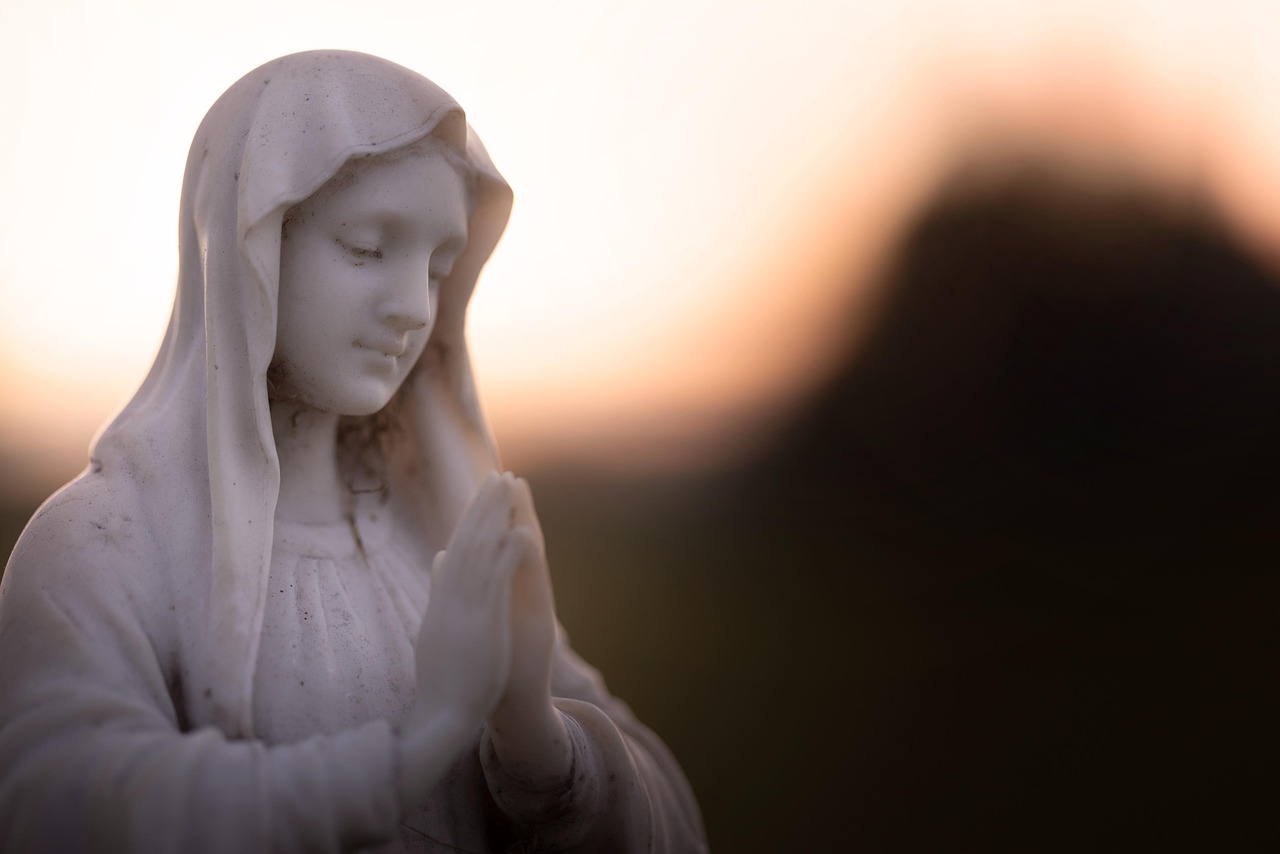
The second article of faith mentions the Virgin Mary: “I believe in Jesus Christ His only Son, our Lord, who was conceived by the Holy Spirit and born of the Virgin Mary”.
Is she mentioned here with the intention of her being an object of worship? No, but instead to acknowledge that in the birth of Jesus, the promise God gave in paradise about the woman’s offspring who was to crush the serpent’s head was fulfilled (Gen. 3:15). Mary became pregnant by the Holy Spirit and gave birth to God’s only Son. This Son was Jesus Christ, who came into the world according to God’s promise to “crush the head of the serpent”, that is, to conquer sin, death, and the power of the enemy of souls, so that people might have the opportunity to be saved.
However, the Virgin Mary was no more divine than you or I. Because of the Fall, she too was subject to original sin like all human beings and therefore completely sinful, just like us: “As it is written: ‘There is no one righteous, not even one; there is no one who understands; there is no one who seeks God. All have turned away, they have together become worthless; there is no one who does good, not even one’” (Rom. 3:10-12). However, in His great mercy, God saw fit to give Mary this important task of being the mother of our Savior.
Faith gave Mary humility
Mary’s humility, engendered by her faith, is reflected in her hymn of thanksgiving (Magnificat): “My soul glorifies the Lord and my spirit rejoices in God my Savior, for he has been mindful of the humble state of his servant. From now on all generations will call me blessed, for the Mighty One has done great things for me—holy is his name. His mercy extends to those who fear him, from generation to generation. He has performed mighty deeds with his arm; he has scattered those who are proud in their inmost thoughts. He has brought down rulers from their thrones but has lifted up the humble. He has filled the hungry with good things but has sent the rich away empty. He has helped his servant Israel, remembering to be merciful to Abraham and his descendants forever, just as he promised our ancestors.” (Luke 1:46–55).
Above, Mary expresses the joy in her heart that her faith has given her. Through faith, she has come to understand that the prophecies of the prophets are now coming true. She would give birth to the Son of God, who would atone for the sins of the whole world, suffering and dying for her sins as well. Mary rejoices that she, an insignificant servant girl, could be God’s servant and part of His great deeds.
We can see from Mary’s hymn of thanksgiving that she did not elevate herself above other people. The reformer Martin Luther also drew attention to this when explaining Mary’s hymn of thanksgiving. According to him, “at the time of Christ’s birth the priests had taken political power for themselves, and the royal family of David was poor and despised. All hope had been lost that a king would rise from among them to great glory. Just when it had sunk to its lowest point of insignificance, Christ came. He was born of a despised tribe and an insignificant, poor servant girl.”…“What God sees and influences happens in the depths, what people see and do happens only on the surface.”
Continuing his explanation of Mary’s hymn of thanksgiving, Luther pauses at the word “humilitas” used in the original text: it is often translated as humility, although in biblical texts “humiliare” means to lower, to render insignificant. If it were translated in the hymn of thanksgiving in the first sense mentioned above, it would give the impression that Mary is praising her own excellence. However, this is not the case for a believer. That is why Christians are referred to as “pauperes”, “afflicti”, and “humiliati”, meaning poor, rejected, and insignificant. Mary also experienced this same insignificance when she praised God. Luther also states that listing one’s own good qualities is a sin and corruption in the eyes of God. For this reason, it is important to note that Mary is not praising herself, but God.
The Bible also tells us how Mary belonged to a despised people: “Look into it, and you will find that a prophet does not come out of Galilee”, said the Pharisees to Nicodemus, who reminded them that no one can be judged until the matter has been investigated according to the laws of Moses (John 7:52). The Pharisees considered the Galileans to be inferior because they were descendants of Jews who had intermarried with other peoples, i.e., they were a mixed people. The Pharisees also expected an earthly king who would reign as the greatest king and thus exalt the people of Israel. They were blind to the fact that Christ, as the atoner and redeemer of sins, is the promised Messiah, the Heavenly King.
Attributes later associated with Mary
Luther thus presents the Virgin Mary as an example of a believer to whom faith opens the writings of the Bible through the Holy Spirit. However, the Roman Catholic Church gave the Virgin Mary attributes based on later traditions and mystical stories. These include Mary’s Immaculate Conception, eternal virginity, and assumption into heaven without dying. Such teachings are not found in the writings of the Bible.
Lutheranism, on the other hand, teaches that Mary was a virgin before the birth of Jesus. After that, Mary and Joseph had several children, as we can read in several passages of the Bible (Matt. 1:24–25, 13:55; Mark 3:31, 6:3; John 7:5; Gal. 1:19). Furthermore, the Gospel of Luke shows that Mary gave birth to her firstborn, which suggests that she had other children with her husband Joseph after that (Luke 2:7). This idea was also supported by Ignatius of Antioch and Justin Martyr.
Is it correct to pray to Mary?
The Roman Catholic Church later created prayers dedicated to Mary, such as the Rosary (Latin: rosarium), in which Mary is prayed to up to 53 times using prayer beads. One of their ideas is that Mary acts as an intercessor. However, the Bible knows only one intercessor for us, who is our risen Savior, Jesus Christ (Rom. 8:34). All the prayers of believers are brought before Him in a golden bowl (Rev. 5:8, 8:3). We should not pray to Mary.
Mary also serves as an example to us in how, after receiving the angel’s announcement, she traveled to the believer Elizabeth, and together they praised God’s goodness and great deeds. They were united by faith through the Holy Spirit.
Even today, the Holy Spirit calls and gathers from the world those whose consciences have been awakened by the word of God through the law. When such a sinner seeking God finds His congregation and believes in the forgiveness of sins that God’s children proclaim through the power of the Holy Spirit, he or she moves from the world to become a member of the congregation formed by the Holy Spirit. And within this congregation, like Mary and Elizabeth, he or she is able to join in the hymn of thanksgiving and praise God for His great mercy, “for the Mighty One has done great things for me”. And thus he or she begins to enjoy righteousness, peace, and joy in the Holy Spirit.
When the Bible mentions Mary for the last time, she had found refuge in the congregation of Christ, in the kingdom of God. She was there together with Jesus’ disciples and Jesus’ brothers, and they were united and prayed without ceasing (Acts 1:14).
Author: Jani Saarenranta
Image: Pixbay