
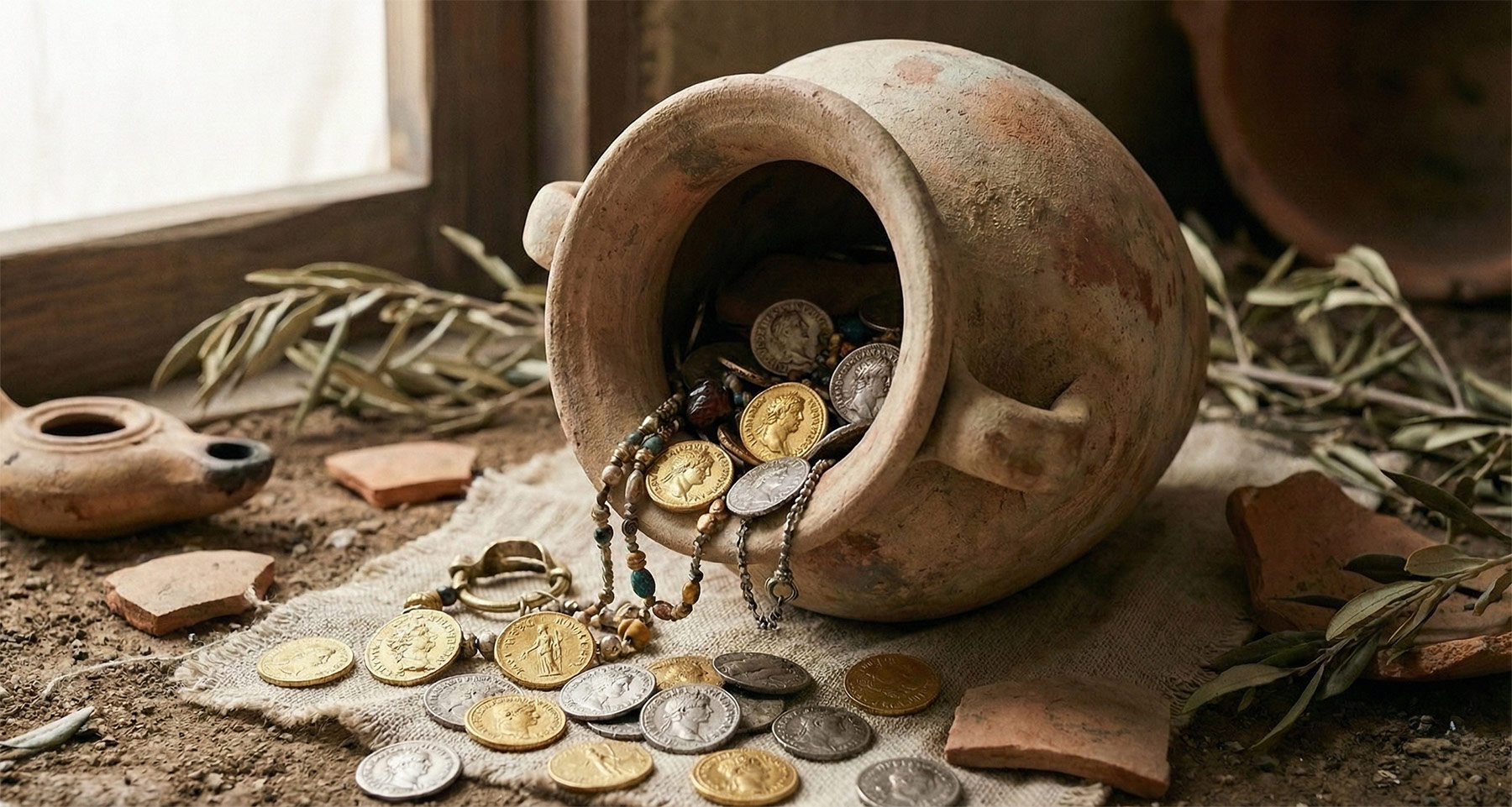
The apostle Paul writes a well-known metaphor in his letter to the Corinthians:
“But we have this treasure in jars of clay to show that this all-surpassing power is from God and not from us” (2 Corinthians 4:7).
This was Paul’s missionary letter to the church he had founded. His work was based on the repentance, or conversion, he had experienced. As a consequence of that repentance, Paul had come to a different understanding of matters of faith than what the Jewish scholars had taught him. His encounter with the risen Jesus on the road to Damascus had changed his life, and three days after this event, Ananias had preached the gospel of forgiveness of sins to him. This event transformed the Pharisee scholar into a follower of Jesus of Nazareth and a worker for the gospel. (Acts 9.)
The proud people of our time have turned away from God. They gather treasures on earth and ignore the word of God. In this way, they climb ever higher on the hills of pride. This article is meant to encourage those who have fallen painfully from these high places and those who see their path leading to ruin. The word of repentance and faith is still a living reality today – the kingdom of God on earth.
God’s treasure – it can be received in the gospel
When Paul wrote about the clay jar, he did not mean he was holding one in his hands. He meant that he himself was the clay jar in which the treasure was hidden—living faith and the subsequent change in his life, obtained through the gospel of forgiveness of sins.
Human beings are created to be eternal beings. That is why Jesus urged us to store up treasures in heaven, not on earth. God helped Paul to repent and believe, and Paul received the treasure when his sins were forgiven. A person who, like Paul, has received the gospel of forgiveness for their sins and saving faith in their heart, will go on to eternal life after death. A person who lives without saving faith, who does not have this treasure, is separated from God because of sin and will be lost in perdition after death.
The Bible teaches that the Fall completely corrupted man. Adam and Eve fell into a trap. The serpent deceived them by tempting and lying to them. Jesus, the Son of God, was the second Adam, who rectified the fall of the first Adam: “‘The first man Adam became a living being;’ the last Adam, a life-giving spirit”. (Rom. 5:19; 1. Cor. 15:45.)
The forgiveness of sins is based on God’s love and mercy. The gospel of Jesus contains the power of God. (Rom. 1:16-17.) For this reason, the reformer Martin Luther (1483-1546) stated that the greatest treasure of the church is the gospel of glory. This treasure, given by God, gives believers hope for eternal life.
What are the clay jars then?
The name Adam comes from the ancient word ʾădāmāh, meaning earth or cultivated land. God created man from the dust of the earth, and after death, the human body returns to the earth. Abraham confessed before God: “I am nothing but dust and ashes” (Genesis 18:27). Likewise, ashes are part of our nature. We mourn our sinfulness like Job, who regretted his sins and sprinkled ashes on himself.
Paul said he was a clay jar. Clay is a cheap material, and when talking about human nature, it can be compared to dust. Clay is useful in farmland when there is just the right amount, but if the field is nothing but clay, it is only good for making pottery.
According to the Bible, God’s view of humanity is harsh. Among other things, Genesis says: “Then the Lord said, ‘My Spirit will not contend with humans forever, for they are mortal; their days will be a hundred and twenty years” (Gen. 6:3). An even more blunt statement is found in a psalm: “The Lord looks down from heaven on all mankind to see if there are any who understand, any who seek God. All have turned away, all have become corrupt; there is no one who does good, not even one” (Ps. 14:2-3).
Humans cannot complain about this view, because it was stated by the Creator himself. The deceitful people of Israel lost God’s protection. Isaiah compared the people to a clay jar: It will break in pieces like pottery, shattered so mercilessly that among its pieces not a fragment will be found for taking coals from a hearth or scooping water out of a cistern. Isaiah continues: This is what the Sovereign Lord, the Holy One of Israel, says: ‘In repentance and rest is your salvation’ (Isaiah 30:14-15).
It is a great miracle that God’s treasure can be in a clay jar. Luther taught that a believer is righteous when he believes, but that does not remove man’s tendency to sin. A believer is therefore simul iustus et peccator, that is, simultaneously sinful and righteous.
Another miracle is that a clay jar can share its treasure, meaning the gospel, with other clay jars. When Jesus forgave the Samaritan woman, he promised: “Everyone who drinks this water will be thirsty again, but whoever drinks the water I give them will never thirst. Indeed, the water I give them will become in them a spring of water welling up to eternal life” (John 4:13-14). Jesus meant that a person whose sins have been forgiven becomes a source of forgiveness and can forgive the sins of others, not by their own power, but by the power of the Holy Spirit in the name and blood of Jesus.
The treasure is hidden in a field
Jesus once told a parable: “The kingdom of heaven is like treasure hidden in a field. When a man found it, he hid it again, and then in his joy went and sold all he had and bought that field” (Matthew 13:44). The man did not take the treasure with him, but hid it back in the field and bought the whole field. Both the treasure and the field where it was found were therefore valuable. Jesus’ parable elevates the value of the field to an astonishingly high position. The man in the parable gave up his former life and repented because he understood he could only obtain the treasure by owning the entire field.
Do you realize, dear reader, that you are now on the threshold of one of Jesus’s most central parables? He presented this parable to us, also – the people of 2026.
God’s congregation on earth is God’s field. Saving faith is found among those who live in that congregation and have living faith. Even today, many people want to possess only God’s treasure, but they are not interested in the field, and therefore they do not receive the treasure for themselves. Paul himself experienced finding the congregation and the treasure as a turning point in his life and rejoiced in it. He also taught about this often and in a meaningful way. (Eph. 2:14-22.)
A good starting point for dialogue between man and God is man’s confession: “Yet you, Lord, are our Father. We are the clay, you are the potter; we are all the work of your hand” (Isaiah 64:8). A sinful person must first seek the kingdom of God. Jesus taught: “Ask and it will be given to you; seek and you will find; knock and the door will be opened to you. For everyone who asks receives; the one who seeks finds; and to the one who knocks, the door will be opened” (Matthew 7:7-8).
God leads the work in His field, where believers are His servants. The writer of the Letter to the Hebrews described Abraham’s faithfulness and humility in the work of the gospel: they were longing for a better country—a heavenly one. Therefore God is not ashamed to be called their God, for he has prepared a city for them (Hebrews 11:16).
“The feet of those who bring the gospel”
God’s word calls all people to own His treasure. Jesus proclaimed: “The time has come… the kingdom of God has come near. Repent and believe the good news!” (Mark 1:15). He left the task of preaching the gospel to His disciples (Matthew 28:19–20) so that anyone who wants to can believe in their preaching and have their sins forgiven.
It is a great thing when a person understands why he is restless and in a bad mood. It all arises from sinfulness. God’s message is direct, as was the message of Nathan, the messenger to King David. He saw the hopelessness of his situation and confessed, “I have sinned against the Lord.” Nathan replied, “The Lord has taken away your sin. You are not going to die” (2 Sam. 12:1–15).
Isaiah 52 contains a beautiful metaphor: “How beautiful on the mountains are the feet of those who bring good news, who proclaim peace, who bring good tidings, who proclaim salvation, who say to Zion, ‘Your God reigns!’” (52:7).
Historically, the gospel meant a message about the end of war, but the Bible uses the same word for forgiveness: peace has been restored between God and sinful humanity because of Jesus’ sacrifice. The message is comforting: Jesus, the Son of God, atoned for the sins of man on the cross at Golgotha. When an unbeliever suffering from a troubled conscience hears the gospel of forgiveness for all sins, their restlessness and bad temper disappear. The internal state of war ends. Joy and thankfulness emerge.
The messenger whose footsteps Isaiah admired is a believer. He is a clay jar who feels unworthy of being the keeper of a treasure. However, because of the importance of the message, he agrees to be an instrument of God’s work. In Psalm 40, David writes how God lifted him out of a slimy pit. (40:2–3). Through Nathan’s sermon, he received forgiveness for his sins and was able to possess God’s treasure within himself, even though he was only a cheap and worthless clay jar, and for this he praised God.
I, too, am a clay jar. I, too, can own God’s treasure. That alone is a miracle. But I have been given the task of spreading the gospel. Hear how the gospel of the Victor over sin, the Risen Savior, is drawing you securely to Himself. Like a good shepherd, He is calling you to repentance and faith and to possess in your heart the kingdom of God, the forgiveness of sins in the name and blood of Jesus. Believing this gives the believer what it promises, and in addition, the living hope of eternal life.
Author: Kingdom of Peace